Showing posts with label landscapes. Show all posts

Wednesday, 10 May 2023

A Week By Loch Hourn


I just had a week of walking and sketching at Arnisdale, on the shores of Loch Hourn. It wasn't many miles for me to travel, but it felt like a real change.  And we took the ferry at Kylerhea - the shortest route for us.  I decided to go there because it's within the Wester Ross Unesco Biosphere, and I'm trying to focus on the Biosphere as the main subject for my next body of work.  The most southerly point is actually in the middle of Knoydart.

View from Arnisdale to Knoydart
 

Arnisdale seems to me to be a special place. It lies at the foot of a very steep hill, crushed up against the sea, and looks out over Loch Hourn to Knoydart, one of the most remote areas of Scotland. The hill that overshadows it is the iconic Beinn Sgritheall, a rather isolated munro mountain...and a rather steep climb.


Glowering Beinn Sgritheall

I wimped out of climbing Beinn Sgritheall, but I did get up as far as some lovely lochans.  Here's one of the views I sketched of the hill viewed across the lochans.


Beinn Sgritheall (blue)

This one gives a better idea.  It's a lovely approach from the west, and not nearly so steep....!

Beinn Sgritheall 2

We stayed in a traditional cottage on the shore - great for weather-watching - we experienced a range of weathers, luckily mostly benign.   Strangely the outlook was similar to our view at home!  Just a bit more dramatic.

Looking west along Loch Hourn

Loch Hourn is a commanding presence.  Many of my sketches are of the Loch.  I did these two when we walked the Herring Path - a fascinating walk, if somewhat awkward in places.  The path is beautifully constructed in several places and is holding up despite a bit of erosion.  And you feel as if you're walking into the past as well as walking closer to Knoydart - almost within touching distance.


Loch Hourn's Little Isles

From the End of the Herring Path

Glen Arnisdale has another long-distance path which apparently was occasionally used in the past for motor-cycle racing (it's barely navigable by bike now).  We walked to the lochans in the glen on a very mature footpath (very steep in places).  I found it rather brooding - this sketch is a bit too bright!


Glen Arnisdale Lochan.

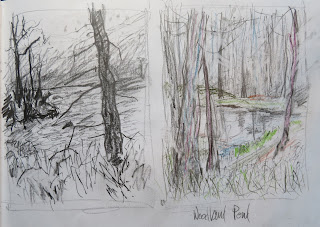
The woodlands were also rather fine.  The trees were mostly oak and birch - beautiful places to sit and sketch.  I think it's a remnant of our Temperate Rain Forest.  And the trees cling to the shore at the bottom of the steep hills.  It was a lovely time of year to go, with the trees just coming into leaf.


Woodland Paths

Woodland By The Shore

You can't go to this area without visiting Sandaig - where Gavin Maxwell once lived.  It is a beautiful spot and we caught it on a lovely day.  The white sand and the rocks reminded me of Iona.  


From above it looks so beautiful too....a most unusual place.


View of Sandaig, with Skye in the Distance

This part of the Biosphere has a pronounced coastal influence - it's everywhere you go.  I hadn't expected to feel such a sense of history – the Herring Path and Glen Arnisdale path feel so old and well-trodden.  Someone kindly lent us a book "Arnisdale and Loch Hourn" which records a past way of life in the area in an engagingly anecdotal way, with lots of old photographs.  Peter English collected the old stories and local lore and compiled the archive.  And the Ceilidh House at Corran has an interesting set of historical interpretation boards.


Loch Hourn From The Slopes of Beinn Sgreathill

What I have taken away from the week is how Arnisdale and environs have such a feel of rugged remoteness and fragility.  Knoydart casts a shadow of enchantment - it's so massive, hardly anyone lives there and it feels unreachable.  And, for an artist, Arnisdale bay has great light and interesting clouds as the weather systems move in and move away.  I think I'll have to return.


Sunday, 23 January 2022

Watery Thinking

Last month I wrote that I thought I would start to explore a Biosphere-related theme. I'm happy to report that I've managed to develop this a little further.  I haven't been confining my work exclusively to biosphere-related ideas, but I'm trying to stick with it.  

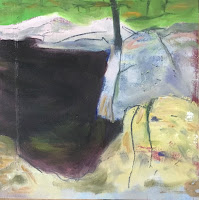
I haven't been back to Garve, to my favourite black river, but I've looked back at my sketches and thought about progressing with the work.  And I've done further sketching in woodland.  However,  I first thought I'd try something out in oils....

Black River - Small Oil WIP

This is a very small oil pic, a study, really.  I'm not sure about this composition and if I was going to do a larger pic I think I'd need to go back and do a series of sketches.  There are some things I like about this, so I think I'll park it and resolve to return to Silverbridge.  

As a trip to Edinburgh is looming, I decided to focus on a different sketch of the river and redraw this on film in preparation for making a new photopolymer plate at Edinburgh Printmakers. The one I thought might make a good print is this one looking across the river.  Here's the final drawing I made on film. I think (hope!) it's got potential....

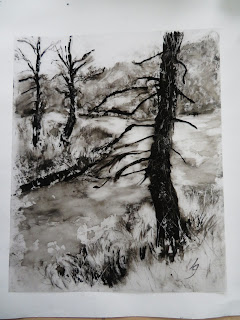
Black River With Trees

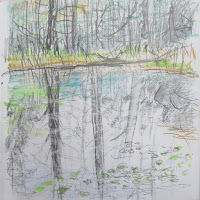
On Monday this week, I returned to my favourite woodland lochan at Achnashellach for more sketching. Of course, this year's mild weather means that there's no snow and ice, so no frozen lochan - I find the lochan's watery surface much more difficult to handle than an icy surface. The interplay between viewing the reflection on the top surface and seeing into the murky depths – it's hard to capture that.  I suppose that's what intrigued Monet about his waterlilies and ponds. Anyway, in this week's sketches I struggled to capture such visual effects, as you can see....


Sketch 1


Sketch 2
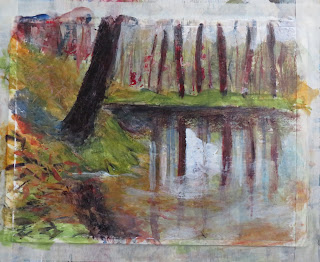
 Sketching was difficult enough, but what about turning these sketches into finished work? Well, all I can say is that I've made a start with this acrylic study - but there's a long way to go. 


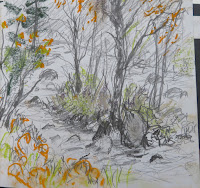
Because I'm heading into Printmakers next week, I was thinking about other Biosphere-related images that I could use as the basis for making a new plate. This took me back to earlier sketches I had done of the river at Achnashellach.

Sketch 3
 

Sketch 4


I did several re-drawings from these and other sketches.....here are a couple of them.

And here's the final drawing on film, ready for making the new plate.

Dark Tree By The River

So this month there's a lot of work in progress and a few unresolved questions.  Will I be able to turn these new finished drawings into new plates? Will they print out well? Can I master the challenge of painting the lochan to show the dreamy interaction between reflected and refracted light? I suppose that's my challenge for next month...


Thursday, 30 December 2021

Starting A New Chapter


2021 has been a busy year and I've never found the time to do any blogging. I've missed it! I think blogging helps me to reflect and improve on the work I'm producing. I shall resolve to try and create more regular blog posts over the next year, using this as my springboard.

I'm developing ideas for a new body of work. I live in a beautiful part of Scotland which was recently designated a UNESCO Biosphere. I'm thinking about doing a series of paintings and prints that are focused on the Biosphere, maybe trying to explore a particular angle or angles. For instance, I was thinking about 'extremities' or 'extremes', or maybe something weather-related with a theme title like 'elemental'.

The Wester Ross Biosphere covers an enormous area with a great variety of landscapes and so another thought is to do several different groups of paintings in an attempt to describe the diversity of the landscapes here. With this in mind, as a start, I've embarked on a series of riverscapes.

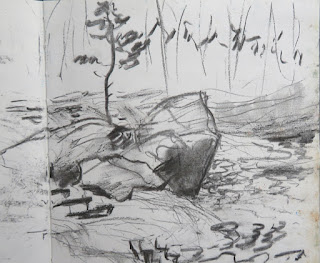
Sketching By The River

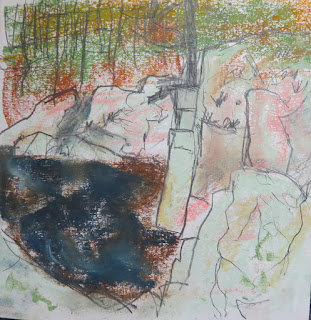
Sketch 1 in pastel
I went for a walk and a sketch at Silverbridge, outside Garve. Garve happens to lie at the eastern extremity of the Biosphere (and so it also fits with the 'extremities' idea - another reason for sketching there). I had heard about this river – the Black Water - and I found it to be a beautiful, atmospheric place. I took lots of photos too.  It was cold and damp.  I haven't done much sketching by rivers, and so it was a bit of a challenge.

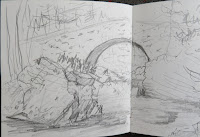
Sketch 2 - pencil drawing of the Wade Bridge


Sketch 3 in charcoal
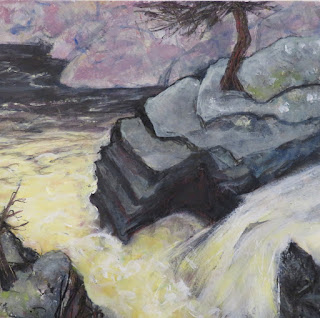
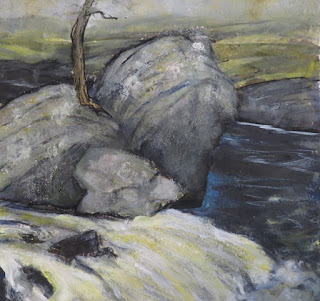
As I sat sketching, I was reminded of the paintings of Tom Thomson (one of the Canadian Group of Seven). I felt that the combination of the fast-flowing river, the pines on the riverbanks, and the sculpted rocks was redolent of the Canadian landscape (or to be more precise, the Algonquin landscape, I think). This was in my head as I sketched, and it came back to me in the studio when I was developing the sketches.

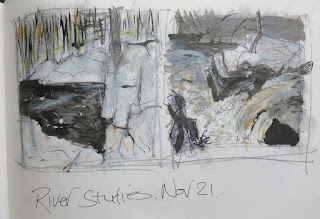
Developing ideas 1
 
Developing ideas 2


The river was in such spate, fast-flowing with foaming waterfalls, yellowish peaty water, and rich dark depths. I had done several sketches on both banks of the river and I re-drew these, also referring to photographs. The mixed woodland (pines and birches) provided a dark backdrop, and as it was a gloomy day, I couldn't see the hills beyond the trees.  


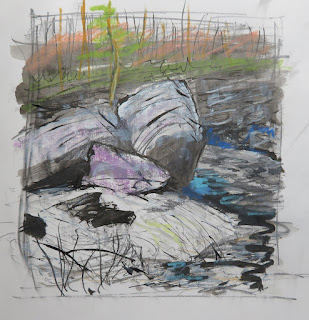
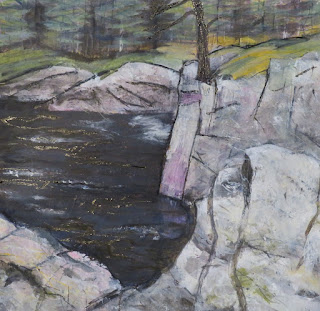
Paintings so far.

Painting 1 (so far)

I decided to focus on three images.  I liked the contrast between the rich black pools and the foaming water, and I loved the amazing rocks. 


Painting 2 (so far)


These paintings are all acrylic on paper. I may go on and do an oil painting based on one or two of them, but for the moment I am resting them – setting them aside before deciding if they are finished or not. I've also been seeking out appropriate river poem quotes. I tried MacCaig first, and found this from his poem “Falls of Measach” - “Waterfalls marking the stages to some rich plunge into the dark”. This did seem to fit with the foaming rapids cascading into darkly rich pools. 


Painting 3 (so far)

 I also found these lines by Mary Oliver from her poem “At The River Clarion”-

“I listened to the voices of the river talking.
Whenever the water struck a stone it had something to say,
and the water itself, and even the mosses trailing under the water.
And slowly, very slowly, it became clear to me what they were saying.”

It strikes me that this might be a good way of describing the mystery of sketching.  What do you think?


Wednesday, 15 January 2020

More Printmaking Experiments

Happy New Year!
I'm having a happy time in the studio trying out various different things.  I've been having great fun making chine colle prints - adding bits of Japanese paper onto prints to give them extra colour or texture.

I started with this one. I felt a little tentative about adding the chine colle and I was teaching myself as I went along, so with this first one I used Japanese paper with wavy lines in order to give the sea a bit more interest. It's a bit tricky as you have to add glue to the paper and then place it on top of the printing plate glue side up so that the paper sticks to the printing paper.  As this result ended up not too messy, I was quite pleased with this as a start and thought I'd continue.
My next effort was to add some colour.  This time I was using an aquatinted copper plate which I had cut off a larger plate I hadn't been happy with.  I had burnished it then re-aquatinted - I was trying to salvage something from this!  'I must be subtle' I thought to myself, so selected some cream-coloured tissue which I hoped would improve the look of the sky, and offset this with a cream-coloured paper with coloured fibres in the foreground. 
Making these prints was stimulating me to think about blocks of colour in the landscape, and also accentuating how light might fall. At this stage I was still trying to be subtle. So here was the next effort with another new photopolymer plate.
But then I got bolder and I thought I might try more of a landscape colour, using the same plate. It's really interesting to compare and contrast the two results, isn't it?
I then thought I'd try colour on another small plate. I wanted to use an orange-coloured paper as the image on the plate was based on an autumnal view in the Gruinard area (near Poolewe).

The first colour shape looked a bit too contrived. So I had a second go with a simpler geometric shape, then with my third go, I finally settled on a simple triangle.


I think this simpler shape has the effect of making the image look more abstract. So now I'm thinking about how to create new images where I might add chine colle colour shapes like this.

The great thing about doing this is that there's always an element of surprise when you pull each new print!