Showing posts with label abstract art. Show all posts

Thursday, 30 December 2021

Starting A New Chapter


2021 has been a busy year and I've never found the time to do any blogging. I've missed it! I think blogging helps me to reflect and improve on the work I'm producing. I shall resolve to try and create more regular blog posts over the next year, using this as my springboard.

I'm developing ideas for a new body of work. I live in a beautiful part of Scotland which was recently designated a UNESCO Biosphere. I'm thinking about doing a series of paintings and prints that are focused on the Biosphere, maybe trying to explore a particular angle or angles. For instance, I was thinking about 'extremities' or 'extremes', or maybe something weather-related with a theme title like 'elemental'.

The Wester Ross Biosphere covers an enormous area with a great variety of landscapes and so another thought is to do several different groups of paintings in an attempt to describe the diversity of the landscapes here. With this in mind, as a start, I've embarked on a series of riverscapes.

Sketching By The River
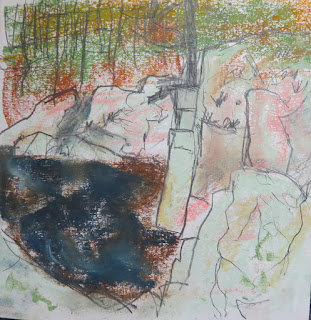
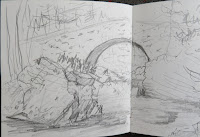
Sketch 1 in pastel
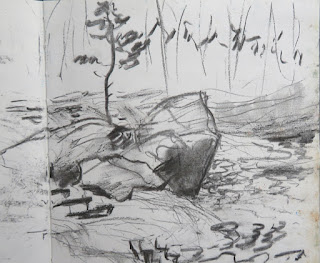
I went for a walk and a sketch at Silverbridge, outside Garve. Garve happens to lie at the eastern extremity of the Biosphere (and so it also fits with the 'extremities' idea - another reason for sketching there). I had heard about this river – the Black Water - and I found it to be a beautiful, atmospheric place. I took lots of photos too.  It was cold and damp.  I haven't done much sketching by rivers, and so it was a bit of a challenge.

Sketch 2 - pencil drawing of the Wade Bridge


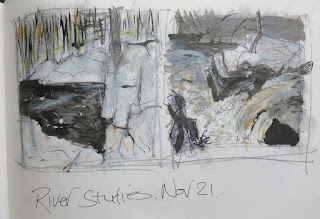
Sketch 3 in charcoal
As I sat sketching, I was reminded of the paintings of Tom Thomson (one of the Canadian Group of Seven). I felt that the combination of the fast-flowing river, the pines on the riverbanks, and the sculpted rocks was redolent of the Canadian landscape (or to be more precise, the Algonquin landscape, I think). This was in my head as I sketched, and it came back to me in the studio when I was developing the sketches.

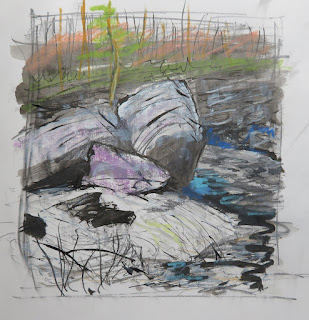
Developing ideas 1
 
Developing ideas 2


The river was in such spate, fast-flowing with foaming waterfalls, yellowish peaty water, and rich dark depths. I had done several sketches on both banks of the river and I re-drew these, also referring to photographs. The mixed woodland (pines and birches) provided a dark backdrop, and as it was a gloomy day, I couldn't see the hills beyond the trees.  


Paintings so far.
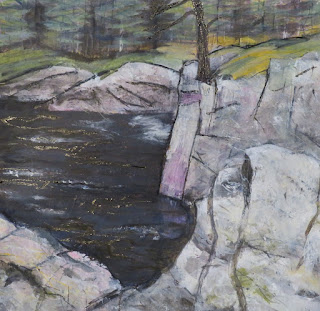
Painting 1 (so far)

I decided to focus on three images.  I liked the contrast between the rich black pools and the foaming water, and I loved the amazing rocks. 


Painting 2 (so far)


These paintings are all acrylic on paper. I may go on and do an oil painting based on one or two of them, but for the moment I am resting them – setting them aside before deciding if they are finished or not. I've also been seeking out appropriate river poem quotes. I tried MacCaig first, and found this from his poem “Falls of Measach” - “Waterfalls marking the stages to some rich plunge into the dark”. This did seem to fit with the foaming rapids cascading into darkly rich pools. 
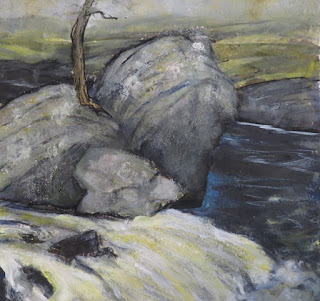
 

Painting 3 (so far)

 I also found these lines by Mary Oliver from her poem “At The River Clarion”-

“I listened to the voices of the river talking.
Whenever the water struck a stone it had something to say,
and the water itself, and even the mosses trailing under the water.
And slowly, very slowly, it became clear to me what they were saying.”

It strikes me that this might be a good way of describing the mystery of sketching.  What do you think?


Sunday, 17 May 2015

A Spot of Reflection

It's harder than people think 'being an artist'. No, really! Self-doubt is a constant companion, made worse by the highs and lows of exhibiting and selling (or not selling!) work. But never mind the generalities, it's time I reflected on what I've done over the last month, what's working for me and what is not.

After the drawing episodes (see previous post), I had a spell of printmaking using a gelatine plate.  I was using bits of bracken and shreds of sacking to act as masks and create textured 'ghost' prints.

This felt like fun rather than work....
Then I tried cutting shapes out of textured material...
 Using thread and bits of lace as well as fish shapes...
And again, mixing shapes and textures...
Becoming more abstract...
And creating bolder abstract shapes....

 Out of all this experimentation I devised a set of basic rules to follow in order to achieve a pleasing result. I used these for a workshop I ran at The Schoolhouse Gallery in Dornie last weekend.  There's a randomness about the gel printmaking process, as I suppose there is about all monoprinting - or monotyping to be pedantic - and it certainly makes me think in more abstract terms about colour, texture and form....which is a jolly good thing.  I think there is a lot of potential for me to use this process to devlop the way I see and use coloured shapes and move away from realism towards abstraction. It keeps me focused on the aesthetics of putting together patterns of different colours that bears no relation to observational drawing.

However, I wanted to get some painting done this month too and I'm determined to work more in oils just to see what kind of results I can achieve. I started with a couple of ideas for lochan pictures, based on some sketches I did while out walking. Here's what I achieved the first session

And this

They look quite good at this scale, but I'm not at all sure about them. Need more work, I think but there is that risk of overworking. And they are a bit too realistic, not abstract enough.

But then I was really doing these to paint myself into another pic I had started a couple of months ago. Here it is...
I was quite pleased with this but thought it needed more work, and it had some elements that were a bit too realistic and the composition looked a little too contrived, too studied.  It is an attempt at an abstracted composition which I had worked out through drawing. My original little study, based on an observational sketch, was this (I've polished this up now and may get it framed - ha!).

What I liked about the scene was the orange island and the blue lochan and how they are opposites and kinda balance each other. However, the oil version wasn't quite working. So I went back to drawing and then back into paint - trying NOT to be realistic - and this is as far as it's got now.
Getting better, I think.  The composition has improved, but maybe the colour is too bright now. I did like the coldness of the earlier version. But that was done in a different season!

I know that I must keep focused on what am I trying to achieve. I'm not trying to create pretty pictures or cartoons: I'm trying to say something about what the landscape means to me: what it says to me - beauty, ruggedness, wildness; what I observe - quirkyness and delicacy; what I feel - preciousness, ephemerality. But there's no point in describing it in words...the challenge is to channel all of that into paint ... ha!


Wednesday, 15 April 2015

More Experimental Drawing (2)


Still working from 'Expressive Drawing' (http://aimoneartservices.com/expressive-drawing-book-/view/378), the next next chapter in the book related to drawing textures.

The book pointed out that in drawing practice there is very little actual texture – you're not creating indentations in the surface of the paper, you're aiming to create the impression of texture, conjuring up an image of texture. Up until now I've always thought of texture as something that is descriptive – I observe what's in front of me and try to describe it through pencil, graphite and charcoal marks. What is new to me is the idea of metaphorical texture – arranging line and mark to describe the internal world of emotion/psyche/spirit. As the book says “It makes the invisible visible, the intangible tangible.”

As I worked through this, all sorts of bells started ringing in my head. Matisse and Klee both talk about delving below the surface into the invisible, of seeking to capture the emotion one feels about a subject rather than visible reality. Kandinsky advises that the artist must express what is peculiar to himself; his eyes should be directed to his own inner life and ears turned to the voice of 'internal necessity'. In his early abstract phase Diebenkorn would routinely reject and destroy paintings that owed too much to the visible world. I know my sketching tends to the 'observational' – I've always thought it is important to capture in a sketch what I see at the time. While this is clearly influenced by the mood I'm in at the time, I cannot pretend that my sketches are a full-blown emotional response to a subject.

So the idea of 'metaphorical texture' interests me greatly!

Let's unpick this a little. It seems to me that to create metaphorical texture one has to set down one's own idiosyncratic marks to describe how one feels about the essence of the subject one is drawing. Abstract artists like Klee created their own language of marks.  If we think that all subjects have hidden depths, we can also recognise that as we observe them we subconsciously bring our own experience into play – what we know or have learned about them, how we have experienced them at first hand, the extent to which we feel comfortable with them/feel unsettled by them/are anxious about them. And I suppose my aim should be to create a personal vocabulary to convey the hidden depths that I see.

Anyway, the exercises in the book were designed to get me thinking about different textures and drawing these.  Then I had to create textures that expressed different emotions. This was my attempt.
 Finally, I had to draw textures from observation without attempting to draw the reality of the objects. (I can see that this is a potential route to invisibility.)  I sat in the dining area with the table and the fire and drew this, a bit like a sampler.
I found it quite difficult, not drawing the objects.  From this last drawing I then had to compose a further drawing using only the textures I had captured.


I think this particular set of exercises sits at the heart of moving from realism to abstraction. I think I should return to it in the future.

In the meantime, to give my head a rest, I finished the day by drawing a Scots Pine that I could observe from my window. I've always been dissatisfied with my previous attempts to draw a Scots pine tree, but this time I tried to focus on the quality of the pine needles and the cloudy appearance of the foliage, thinking about the invisibility of the tree. I thought it turned out quite well and that it's a little different from my other sketches.  I thought I could detect some influence from my drawing session.  Maybe I'm beginning to let go from realism a little. What do you think?
 I will return to this again soon!

More Experimental Drawing (1)

Have had a bit of a break from painting - first there was the exhibition, then I was ill, followed by my London trip (and visit to the Diebenkorn), etc. Must be my longest break for a while. But I'm back into work mode now. Thought I'd try some more experimental 'expressive drawing' to get me up to speed. (I started this in early March - Blog Post 2nd March - based on the book 'Expressive Drawing' http://aimoneartservices.com/expressive-drawing-book-/view/378)

When I left off, I had just finished doing Line and Mark with this drawing - the aim was to create a 'conversation between expressive lines'. This was to be done spontaneously - no pre-planning at all - and I was seeking to have a dialogue between two or three linear 'characters'. It's quite hard doing these things at the time and very interesting to look back at the result now.
It's interesting to look at this drawing having been to the Diebenkorn exhib. I noticed that in his earlier abstract phase he used line a lot and I did like the effect. I did feel a strange sense of satisfaction after doing this drawing.

Now I had to start exploring 'shape'. What type of shape?
  • Geometric & organic
  • Static and directional
  • Simple & complex
  • Angular and curvilinear
  • and more
and then create 3 shape compositions using, first, one circle, one square and one equilateral triangle. Here are the results. Looks like I ended up exploring relationships between the shapes - from stand-off to touching and then overlapping - my logical mind at work, I think.


In the next exercise I had to use an oval, an elongated triangle and a rectangle. Here's how they turned out.


At this stage I'm not really composing the picture in a premeditated way, just being intuitive with these shapes and then looking at the differences between the two sets of drawings. I think the second set of drawings gives a greater sense of tension and movement than the first.

In the final drawing exercises relating to 'shape', I was asked first to mix angular and curvilinear shapes in a composition. Here's what I did.
And then I was asked to mix organic and geometric shapes in compositions.
Interesting results for me. I've never created any drawings like these before. It was challenging and exciting, almost liberating, and has definitely got me thinking about the role played by shapes in a drawing/painting. I feel as if I'm learning something here!  Letting go of realism, perhaps?


Monday, 2 March 2015

Trying Something Different

I hate standing still. There's so much I don't know I don't know. As far as art is concerned I want to learn and understand more. Now that I'm a full-time artist I feel that I need to delve a bit deeper into theories of art and art history.  Reading Vasari is not enough. I also want to try new things and experiment.

I was reading Herbert Read on Th Philosophy of Modern Art and things started to fall into place for me. He discusses art in terms of realism, symbolism and expressionism: although I knew the basics, reading more about them - and more importantly how artists have moved from one to the other and back again - is giving me more to think about. Up until now I have felt that I cannot move away from observation, that I will always be representational to a certain extent, but I feel a bit liberated having read this.

I had bought a book on 'Expressive Drawing' some time ago, but I didn't feel inclined to dip into it. Now I've been reading it and working through the exercises. It's taking me back to square one, starting again with drawing, but a different kind of drawing. I thought I'd share a few images with you. The starting point was to draw without thinking, drawing with an empty mind. So I started with this.

Then I had to add a little more.
Probably a bit too messy in the end. I found it difficult to draw without trying to represent something.

Another exercise was to draw different feelings. For example, here is 'confused'
And here is 'rhythmic'

And so on.
In another exercise I had to create a picture using only one type of mark -making marks and rubbing out/covering over -  in this case using straight lines
And then create another picture using contrasting lines.
Continuing the idea of contrast, there were some exercises relating to the direction of lines - horizontal, vertical and diagonal, and I had to create 3 pics using all 3 lines but with a different direction dominating.
Here is HORIZONTAL
Here is VERTICAL

And here is DIAGONAL


Looking over these drawings now I find them quite interesting. I want to note this all down and keep a record of it. It is so different from my usual practice, but very enriching, I think. And, I suspect, a route to greater expressionsm and abstraction. Anyway, more anon as I'm planning to work through the book gradually (at the same time as continuing to paint!)

In the meantime, I found this link to the book and the artist if you're interested
http://aimoneartservices.com/expressive-drawing-book-/view/378.